


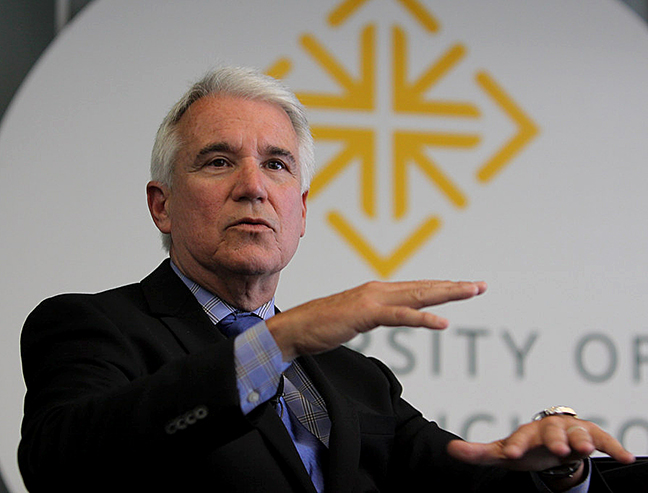
George Gascon is an American attorney and the District Attorney of Los Angeles County. He was elected in 2020 after receiving $2.25 million from George Soros during the campaign, and has been criticized for his left-progressive criminal justice policies.12 A recall effort against him is currently underway.3
Gascon was born in Cuba in 1954, which he fled with his family in 1967 when he was 13. Gascon was a sergeant in the Army and later became a police officer with the Los Angeles Police Department.4 After stints as chief of police in both Mesa, AZ, and San Francisco, CA, Gascon was appointed District Attorney of San Francisco by then-Mayor Gavin Newsom in January 2011.5 He was elected district attorney of Los Angeles in 2020.6
Early Life and Education
George Gascon was born in Cuba in 1954. While his parents initially supported Fidel Castro’s revolution, the family fled Cuba after Gascon’s father lost his job and Gascon’s uncle, a union organizer, was imprisoned for over a decade.7 The family left Cuba by a “freedom flight” to Miami, FL, and later settled in Los Angeles, CA. After struggling to learn English, Gascon dropped out of high school and worked in a grocery store.8 Gascon enlisted in the United States Army at the age of 18 and became the youngest sergeant in his brigade. During his time in the army, he finished high school and earned his bachelor’s degree in history from California State University Long Beach.9
Early Career
After receiving his bachelor’s degree, Gascon joined the Los Angeles Police Department as a patrol officer in the Hollywood division. While working for the LAPD, Gascon earned a law degree from Western State University College of Law.10 After rising through the ranks, he became Assistant Police Chief under Bill Bratton, overseeing more than 9,000 Los Angeles police officers.11
Gascon was hired to be the police chief of Mesa, AZ, in 2006. He became famous for opposing then-Maricopa County Sheriff Joe Arpaio’s immigration enforcement efforts, using Mesa police officers to provide “police protection” during one of Arpaio’s immigration raids.12 In 2009, Gavin Newsom, who was the Mayor of San Francisco at the time, hired Gascon as police chief in San Francisco.13
San Francisco DA
In 2011, Newsom appointed Gascon District Attorney of San Francisco after Kamala Harris, who was the DA at the time, was elected attorney general of California. Gascon became the first Latino to hold the office and the first police chief in the country to become District Attorney.14
As DA of San Francisco, Gascon advocated for left-progressive changes to criminal justice policy. He exonerated thousands of individuals for drug convictions and co-authored Proposition 47, a California ballot initiative which made certain property crimes and drug crimes misdemeanors instead of felonies.15 Gascon advocated against building a new jail in San Francisco, and he continued to oppose immigration enforcement efforts by ICE agents, upholding San Francisco’s “sanctuary city” policies.16
During his tenure as DA of San Francisco, property crime increased by 49%. The increase was driven by vehicle break-ins, and violent crime overall rose 15%.17 Gascon was also criticized by national Republicans, including Donald Trump, for his handling of a murder trial in which an illegal was accused of shooting Kate Steinle, a young woman who was killed on Pier 14 in San Francisco. In response, Gascon called Trump a “madman.”18
In 2018, Gascon announced that he would not seek reelection after being reelected in 2011 and 2015, citing the need to move back to Los Angeles to care for his elderly mother.1920
Los Angeles District Attorney
Election
In 2019, Gascon resigned as San Francisco District Attorney, saying he and his wife were going back to Los Angeles to “rejoin our family and explore a run for District Attorney.”21 He later formally announced his candidacy, opposing incumbent Jackie Lacey. Gascon promised to enact progressive criminal justice policies, promising to “turn our court system upside down.”22
Lacey promised to continue prosecuting arrests at a higher rate than Gascon while diverting mentally ill individuals into treatment programs.23
The two candidates spent a total of $19.4 million during the campaign, with Lacey spending $7 million and Gascon spending $12.4 million.24 Lacey received most of her funding from California law enforcement and corrections officers’ unions. Gascon was primarily funded by wealthy left-progressive political donors such as George Soros, Reed Hastings, and Elizabeth Simons.25 Gascon won the election in November 2020.26
Policies
After entering office, Gascon issued 9 special directives which changed many policies enacted by previous DAs.27 Gascon ended the use of cash bail, published a list of 13 misdemeanors which he said should not be prosecuted, and enacted a blanket ban on charging juveniles in adult court. He also prohibited prosecutors from seeking the death penalty and established teams of prosecutors to review prior convictions.28
Gascon prohibited prosecutors from enforcing California’s three strikes law and other sentencing enhancements in California criminal law. The Association of Deputy District Attorneys for Los Angeles County, a union representing Los Angeles prosecutors, sued Gascon, stating that he did not have the authority to refuse to enforce those provisions.29 Gascon’s policy was enjoined by a Los Angeles Superior Court judge, and a California appellate court upheld the injunction. Gascon announced plans to appeal the ruling, and the prosecutors union subsequently stated that Gascon “is convinced that the rule of law doesn’t apply to him.”30
Effects
During Gascon’s tenure, crime had risen significantly in Los Angeles. In 2021, homicides rose by 11.8% and shootings rose by 9%.31 LA County Sheriff Alex Villanueva said during a virtual town hall that from 2019 to 2021, homicides have risen by 94.24% and grand theft auto has increased by 64.88%.32 Union Pacific railroad officials announced in January 2022 that rail thefts increased by 160% in 2021, but that defendants were being released due to Gascon’s policies on cash bail and misdemeanors.33
Recall
Opponents of Gascon’s policies attempted to recall him in 2021 but were not able to gather enough signatures to place the recall on the ballot for the 2021 election.34 A second recall attempt in 2022 submitted more than 700,000 signatures to the Los Angeles County Registrar-Recorder/County Clerk. A minimum of 566,857 signatures are necessary for the recall to be voted on in the November 2022 election.35
Many Los Angeles deputy district attorneys, who have openly disparaged Gascon’s policies, openly supported the recall effort despite continuing to work for Gascon.36 In February 2022, the Los Angeles Deputy District Attorneys Association held a vote on whether to support Gascon’s recall. Over 80% of members voted, and almost 98% of voting members voted to support the recall.37
References
- Moore, Maloy, Ryan Menezes, and James Queally. “Here are the mega-donors and police unions pouring millions into the L.A. County district attorney race.” Los Angeles Times, November 3, 2020. https://www.latimes.com/projects/la-district-attorney-race-top-donors/.
- Thayer, Parker. “Living Room Pundit’s Guide to Soros District Attorneys.” Capital Research Center, January 18, 2022. https://capitalresearch.org/article/living-room-pundits-guide-to-soros-district-attorneys/.
- Arango, Tim. “Los Angeles Just Elected a Liberal D.A. He’s Already Facing a Recall Effort.” The New York Times, June 19, 2021.” https://www.nytimes.com/2021/06/19/us/george-gascon.html.
- Roberts, Chris. “Beyond the Law: District Attorney George Gascón’s threat to San Francisco’s business as usual.” SF Weekly, June 8, 2016. https://www.sfweekly.com/news/beyond-the-law-district-attorney-george-gascons-threat-to-san-franciscos-business-as-usual/.
- Roberts, Chris. “Beyond the Law: District Attorney George Gascón’s threat to San Francisco’s business as usual.” SF Weekly, June 8, 2016. https://www.sfweekly.com/news/beyond-the-law-district-attorney-george-gascons-threat-to-san-franciscos-business-as-usual/.
- KPCC. “LA District Attorney: What George Gascón’s Win Over Jackie Lacey Means For Criminal Justice Reform.” November 9, 2020. LA District Attorney: What George Gascón’s Win Over Jackie Lacey Means For Criminal Justice Reform | KPCC – NPR News for Southern California – 89.3 FM.
- Roberts, Chris. “Beyond the Law: District Attorney George Gascón’s threat to San Francisco’s business as usual.” SF Weekly, June 8, 2016. https://www.sfweekly.com/news/beyond-the-law-district-attorney-george-gascons-threat-to-san-franciscos-business-as-usual/.
- George Gascon for LA District Attorney 2020. “Meet George.” https://www.georgegascon.org/meet-george/. Accessed July 19, 2022.
- Guthrie, Julian. “From high school dropout to police chief to DA’s office.” SFGate, August 3, 2013. https://www.sfgate.com/bayarea/article/From-high-school-dropout-to-police-chief-to-DA-s-4705542.php.
- Guthrie, Julian. “From high school dropout to police chief to DA’s office.” SFGate, August 3, 2013. https://www.sfgate.com/bayarea/article/From-high-school-dropout-to-police-chief-to-DA-s-4705542.php.
- George Gascon for LA District Attorney 2020. “Meet George.” https://www.georgegascon.org/meet-george/. Accessed July 19, 2022.
- Roberts, Chris. “Beyond the Law: District Attorney George Gascón’s threat to San Francisco’s business as usual.” SF Weekly, June 8, 2016. https://www.sfweekly.com/news/beyond-the-law-district-attorney-george-gascons-threat-to-san-franciscos-business-as-usual/.
- Roberts, Chris. “Beyond the Law: District Attorney George Gascón’s threat to San Francisco’s business as usual.” SF Weekly, June 8, 2016. https://www.sfweekly.com/news/beyond-the-law-district-attorney-george-gascons-threat-to-san-franciscos-business-as-usual/.
- George Gascon for LA District Attorney 2020. “Meet George.” https://www.georgegascon.org/meet-george/. Accessed July 19, 2022.
- Eskenazi, Joe. “George Gascón may be this city’s most progressive DA yet. Voters might still send him packing.” Mission Local, July 10, 2018. https://missionlocal.org/2018/07/george-gascon-may-be-this-citys-most-progressive-da-yet-voters-might-still-send-him-packing/.
- Eskenazi, Joe. “George Gascón may be this city’s most progressive DA yet. Voters might still send him packing.” Mission Local, July 10, 2018. https://missionlocal.org/2018/07/george-gascon-may-be-this-citys-most-progressive-da-yet-voters-might-still-send-him-packing/.
- Queally, James. “How Jackie Lacey’s and George Gascón’s time in office shapes the L.A. County D.A.’s race.” Los Angeles Times, February 18, 2020. How Jackie Lacey’s and George Gascón’s visions shape D.A.’s race – Los Angeles Times (latimes.com).
- KTVU (Fox2). “SF D.A. Gascon accepts responsibility for failures in Steinle case, calls Trump a ‘madman.’” December 5, 2017. https://www.ktvu.com/news/sf-d-a-gascon-accepts-responsibility-for-failures-in-steinle-case-calls-trump-a-madman.
- Lagos, Marisa. “San Francisco District Attorney George Gascón Won’t Seek Third Term.” KQED, October 2, 2018. https://www.kqed.org/news/11696186/san-francisco-district-attorney-george-gascon-wont-seek-third-term.
- Eskenazi, Joe. “George Gascón may be this city’s most progressive DA yet. Voters might still send him packing.” Mission Local, July 10, 2018. https://missionlocal.org/2018/07/george-gascon-may-be-this-citys-most-progressive-da-yet-voters-might-still-send-him-packing/.
- Lagos, Marisa. “San Francisco District Attorney George Gascón Resigns.” KQED, October 3, 2019. https://www.kqed.org/news/11778096/san-francisco-district-attorney-george-gascon-resigns.
- Stoltze, Frank. “George Gascon Has Said ‘We Need To Turn Our Court System Upside Down.’ Now He’s Running To Be LA’s Next DA.” LAist, October 28, 2019. https://web.archive.org/web/20200509132154/https://laist.com/2019/10/28/lapd-george-gascon-los-angeles-district-attorney-da-jackie-lacey.php.
- Queally, James. “How Jackie Lacey’s and George Gascón’s time in office shapes the L.A. County D.A.’s race.” Los Angeles Times, February 18, 2020. How Jackie Lacey’s and George Gascón’s visions shape D.A.’s race – Los Angeles Times (latimes.com).
- Moore, Maloy, Ryan Menezes, and James Queally. “Here are the mega-donors and police unions pouring millions into the L.A. County district attorney race.” Los Angeles Times, November 3, 2020. https://www.latimes.com/projects/la-district-attorney-race-top-donors/.
- Moore, Maloy, Ryan Menezes, and James Queally. “Here are the mega-donors and police unions pouring millions into the L.A. County district attorney race.” Los Angeles Times, November 3, 2020. https://www.latimes.com/projects/la-district-attorney-race-top-donors/.
- George Gascon for LA District Attorney 2020. “Meet George.” https://www.georgegascon.org/meet-george/. Accessed July 19, 2022.
- Stimson, Charles, and Zack Smith. “Meet George Gascón, the Rogue Prosecutor Whose Policies Are Wreaking Havoc in Los Angeles.” The Heritage Foundation, February 24, 2021. https://www.heritage.org/crime-and-justice/commentary/meet-george-gascon-the-rogue-prosecutor-whose-policies-are-wreaking.
- Stimson, Charles, and Zack Smith. “Meet George Gascón, the Rogue Prosecutor Whose Policies Are Wreaking Havoc in Los Angeles.” The Heritage Foundation, February 24, 2021. https://www.heritage.org/crime-and-justice/commentary/meet-george-gascon-the-rogue-prosecutor-whose-policies-are-wreaking.
- Melugin, Bill, and Mary Stringini. “Judge issues injunction barring Gascón’s new directives, says the DA must ‘comply with the law.’” Fox11, February 8, 2021. https://www.foxla.com/news/judge-orders-la-county-da-george-gascon-to-comply-with-the-law.
- City News Service. “Prosecutors Union Blasts Gascón for Appeal of Ruling on Prior Strikes.” KFI, July 15, 2022. https://kfiam640.iheart.com/featured/la-local-news/content/2022-07-15-prosecutors-union-blasts-gascn-for-appeal-of-ruling-on-prior-strikes/.
- City News Service. “LA sees 12% spike in homicides: ‘Los Angeles is not alone in this trend,’ Mayor Garcetti says.” ABC7, January 16, 2022. https://abc7.com/lapd-crime-homicides-statistics/11476915/.
- City News Service. “Homicides rose 94% in LA County from 2019 to 2021, auto thefts up 65%, Sheriff Villanueva says.” ABC7, January 13, 2022. https://abc7.com/homicide-auto-theft-los-angeles-county-villanueva/11463877/.
- Caprariello, Alex, and Cassie Buchanan. “Looters raiding LA cargo trains of Amazon, UPS shipments.” Newsnation, January 14, 2022. https://www.newsnationnow.com/us-news/west/looters-stealing-amazon-ups-packages-from-la-trains/.
- Ballotpedia. “George Gascón recall, Los Angeles County, California (2021-2022).” https://ballotpedia.org/George_Gasc%C3%B3n_recall,_Los_Angeles_County,_California_(2021-2022). Accessed July 20, 2022.
- Vakil, Caroline. “Here’s what to know about the Los Angeles County DA recall effort.” The Hill, July 17, 2022. https://thehill.com/homenews/campaign/3561848-heres-what-to-know-about-the-los-angeles-county-da-recall-effort/.
- Lizza, Ryan. “LA wants to recall its most progressive prosecutor. Inside the DA’s hostile office.” Politico, July 15, 2022. https://www.politico.com/news/2022/07/15/george-gascon-deep-dive-00045603.
- Ballotpedia. “George Gascón recall, Los Angeles County, California (2021-2022).” https://ballotpedia.org/George_Gasc%C3%B3n_recall,_Los_Angeles_County,_California_(2021-2022). Accessed July 20, 2022.