


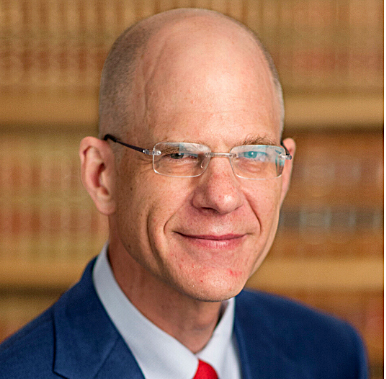
Edward B. Foley is a law professor who has written on left-of-center election-administration issues for the Washington Post. Foley advocates for expanded early voting, mail-in voting, and other changes to election laws to increase participation.
Foley has been outspoken in his opposition to President Donald Trump. Foley has called for Trump to be tried for the January 6, 2021 riot at the Capitol, called Trump a fascist, imagined scenarios in which Trump could steal an election, and suggested that Trump may attempt to illegitimately try to “take” the presidency in 2025.
Background
Edward B. Foley is a law professor at Ohio State University focusing on elections and the Constitution and directs the law school’s election-law program. 1 Foley is also an election opinion writer for the Washington Post. 2 Foley also serves as a member of the National Task Force on Election Crises, a self-described bipartisan organization promoting fair elections. 3 Foley has a B.A. in history from Yale University and J.D. from Columbia University School of Law. 4 He was a law clerk to Supreme Court Justice Harry Blackmun and solicitor for the State of Ohio from 1999-2000. 5
Views
Foley has argued that new state voting law changes passed after the 2020 election revoked citizens voting rights. 6 Foley advocates for expanded early voting and allowing anyone to vote by mail. 7 He has called on the U.S. Senate to change the filibuster rule to pass election legislation. 8 Foley has argued against the current primary election system, where a plurality winner can become a party nominee, and argues a nominee must achieve a majority vote to move to the general election. 9
In a 2021 debate organized by the Federalist Society, Foley argued for the American Constitution Society, a left-leaning legal organization. 10 Foley is also listed as an expert for ElectionSOS, a self-described non-partisan database of election experts for journalists that consists mainly of members of left-of-center organizations. 11
Foley has advocated for ranked-choice voting in elections and stated it is a way to “counter Trump’s authoritarian tendencies.” 12 He contends that ranked voting would “diminish the severe danger that Trump’s facsimile of fascism poses for both party and country.” 13 Foley has referred to the Make America Great Again movement as “hostility toward democracy itself.” 14 Foley has described Trump-backed candidate Harriet Hageman, running for Congress against Rep. Liz Cheney (R-WY), as an election-subversion apologist. 15
The self-described nonpartisan National Task Force on Election Crises, of which Foley is a member, has argued that President Trump “incited a violent insurrection” on January 6, 2021 and “this attack on our democracy culminated with white supremacist rioters attacking the Capitol seeking to not only overturn the Constitutional order, but also take hostages and assassinate members of Congress and the Vice President.” 16
During the 2020 election, Foley presented a series of hypothetical situations involving mail-in ballots, including then-Attorney General William Barr seizing mail-in ballots, claiming they violate the Constitutional rights of people who voted in person. 17 Foley also hypothesized about President Trump using the military to seize mail-in ballots. 18 Under a third hypothetical, Foley imagined a scenario where “a mob of pro-Trump agitators” storm a building and set mail-in ballots on fire. 19
Foley has stated that “the threat that Donald Trump will try to illegally seize power on Jan. 6, 2025—is real and dire.” 20 In 2021, Foley participated in a conference on election subversion discussing how Trump was endeavoring in an illegitimate comeback by endorsing candidates for political office. 21 Foley has written on Trump’s involvement in the January 6, 2021 riot at the Capitol, arguing that Trump could be charged under the federal insurrection statute or the seditious conspiracy statute. 22 Foley argued that it should be up to a jury to determine whether Trump threatened democracy and be criminally punished for it. 23
References
- “Edward B. Foley.” Ohio State University Moritz College of Law. Accessed June 9, 2022. https://moritzlaw.osu.edu/edward-b-foley.
- “Edward B. Foley.” Washington Post. Accessed June 9, 2022. https://www.washingtonpost.com/people/edward-b-foley/.
- “Members.” National Task Force on Election Crises. Accessed June 9, 2022. https://www.electiontaskforce.org/members.
- “Edward B. Foley.” Ohio State University Moritz College of Law. Accessed June 9, 2022. https://moritzlaw.osu.edu/edward-b-foley.
- Edward B. Foley Curriculum Vitae. Ohio State University Moritz College of Law. Accessed June 9, 2022. https://moritzlaw.osu.edu/sites/default/files/2021-12/foley%202021.pdf.
- Foley, Edward B. “Voting Rights Are in Trouble. HR 1 Isn’t Going to Pass – But This Could.” Washington Post. March 8, 2021. Accessed June 9, 2022. https://www.washingtonpost.com/opinions/2021/03/08/saving-voting-rights-is-an-emergency-heres-modest-fix-republicans-might-support/.
- Foley, Edward B. “Democrats Have a Chance to Expand Voter Access. But They’re Focusing on the Wrong Bill.” Washington Post. March 29, 2021. Accessed June 9, 2022. https://www.washingtonpost.com/opinions/2021/03/29/democrats-have-chance-expand-voter-access-theyre-focusing-wrong-bill/.
- [1] Foley, Edward B. “Democrats Have a Chance to Expand Voter Access. But They’re Focusing on the Wrong Bill.” Washington Post. March 29, 2021. Accessed June 9, 2022. https://www.washingtonpost.com/opinions/2021/03/29/democrats-have-chance-expand-voter-access-theyre-focusing-wrong-bill/.
- Foley, Edward B. “How Our System of Primary Elections Could Destroy Democracy.” Washington Post. May 19, 2022. Accessed June 13, 2022. https://www.washingtonpost.com/opinions/2022/05/19/primary-elections-majority-vote/.
- “Edward Foley.” The Federalist Society. Accessed June 9, 2022. https://fedsoc.org/contributors/edward-foley.
- “Edward Foley.” ElectionSOS. Accessed June 9, 2022. https://electionsos.com/coach/edward-b-foley/.
- Foley, Edward B. “Can Alaska Save Democracy?” Washington Post. February 10, 2022. Accessed June 9, 2022. https://www.washingtonpost.com/opinions/2022/02/10/alaska-ranked-choice-voting-senate-murkowski/.
- [1] Foley, Edward B. “Can Alaska Save Democracy?” Washington Post. February 10, 2022. Accessed June 9, 2022. https://www.washingtonpost.com/opinions/2022/02/10/alaska-ranked-choice-voting-senate-murkowski/.
- Foley, Edward B. “How Our System of Primary Elections Could Destroy Democracy.” Washington Post. May 19, 2022. Accessed June 13, 2022. https://www.washingtonpost.com/opinions/2022/05/19/primary-elections-majority-vote/.
- [1] Foley, Edward B. “Can Alaska Save Democracy?” Washington Post. February 10, 2022. Accessed June 9, 2022. https://www.washingtonpost.com/opinions/2022/02/10/alaska-ranked-choice-voting-senate-murkowski/.
- “Resources.” National Task Force on Election Crises. Accessed June 9, 2022. https://www.electiontaskforce.org/resources.
- Foley, Edward B. “A November Nightmare Part 1: What if Mailed Ballots are Never Counted.” Harvard Law Review blog. August 30, 2020. Accessed June 10, 2022. https://blog.harvardlawreview.org/a-november-nightmare-part-i-what-if-mailed-ballots-are-never-counted/.
- Foley, Edward B. “A November Nightmare Part 1: What if Mailed Ballots are Never Counted.” Harvard Law Review blog. August 30, 2020. Accessed June 10, 2022. https://blog.harvardlawreview.org/a-november-nightmare-part-i-what-if-mailed-ballots-are-never-counted/.
- Foley, Edward B. “A November Nightmare Part 1: What if Mailed Ballots are Never Counted.” Harvard Law Review blog. August 30, 2020. Accessed June 10, 2022. https://blog.harvardlawreview.org/a-november-nightmare-part-i-what-if-mailed-ballots-are-never-counted/.
- Foley, Edward B. “The Threat of Trump Illegally Taking Power in 2025 is Real. Here’s What Congress Can Do.” Washington Post. September 28, 2021. Accessed June 13, 2022. https://www.washingtonpost.com/opinions/2021/09/28/three-fixes-congress-should-make-save-democracy/.
- Foley, Edward B. “The Threat of Trump Illegally Taking Power in 2025 is Real. Here’s What Congress Can Do.” Washington Post. September 28, 2021. Accessed June 13, 2022. https://www.washingtonpost.com/opinions/2021/09/28/three-fixes-congress-should-make-save-democracy/.
- Foley, Edward B. “Prosecuting Trump for the Capitol Riot Will Be Difficult – But Not Impossible.” Washington Post. January 14, 2021. Accessed June 13, 2022. https://www.washingtonpost.com/opinions/2021/01/14/can-trump-be-prosecuted-capitol-riot/.
- Foley, Edward B. “Prosecuting Trump for the Capitol Riot Will Be Difficult – But Not Impossible.” Washington Post. January 14, 2021. Accessed June 13, 2022. https://www.washingtonpost.com/opinions/2021/01/14/can-trump-be-prosecuted-capitol-riot/.