

National Education Association (NEA)
The National Education Association (NEA) is a left-of-center teacher’s union that is, as of 2026, America’s largest labor union representing nearly three million employees, principally teachers. 1, NEA represents teachers, education support professionals, retired teachers, education faculty and staff, substitute teachers, and administrators.2 The NEA exercises significant political power, particularly within Democratic politics and has spent millions each election cycle, the vast majority of which is directed in support of Democrats and in opposition to Republicans. The NEA also conducts contract negotiations and a significant amount of issue advocacy and lobbying. 3 4

Contents
The NEA is a major political player, with its associated political action committees (PACs) contributing $134.5 million to federal candidates and committees—97 percent of which supported Democrats and liberals—from 1990 through 2024, while also reporting $75 million in lobbying expenses from 1998 to 2026, and $27 million in outside spending from 2000 to 2024. 5
Organizational Overview
Creation
NEA was founded in 1857 as the National Teachers Association (NTA) when 43 teachers and college professors met in Philadelphia in order to advocate for public education, with a fourth of the group’s founding members coming from higher education institutions. 6 It changed its name to “the National Education Association” in 1870. 7 Zalmond Richards—founder of Union Academy in Washington, D.C. and a faculty member at Columbian College, now known as George Washington University—became NEA’s first president. 8 9
Early Issue Advocacy
NEA has a long history of issue advocacy, beginning with support for the Morrill Act of 1862, which supported land-grant colleges and the creation of public state universities.10 In 1867, NEA successfully lobbied Congress to create the first federal Department of Education,11 which was almost solely devoted to collecting information to help states create public school systems. In 1866, the NEA opened its membership to women. 12
In the 20th century, the NEA began to promote state pension plans in 1923. By 1950, every state had a pension plan.13 By the mid 20th century, NEA was advocating for more controversial policies, such as advocating for the Bilingual Education Act, providing federal funding for the development and implementation of bilingual education programs, in 1968.14
Over the intervening century from founding to 1957, NEA grew from its original 43 to 700,000 members.15 A mere two years after its Centennial, NEA won one of its largest victories: Wisconsin became the first state to allow collective bargaining for public-sector unions.15
Modern Advocacy
Since the mid-19th century, the NEA has become largest union in the United States, reporting over three million members at its peak in 2008-2010 and 2.8 million as of its August 2025 Labor Department filing. 1 The group is among the most notable organizations in U.S. politics, and is a significant player in left-of-center policy and Democratic political infrastructure. The union is notably not affiliated with the AFL-CIO labor federation, and has historically had a rivalry with the American Federation of Teachers (AFT), an AFL-CIO affiliate. While both unions are large funders of Democratic campaigns and supportive of left-of-center policy priorities, the AFT has been described as historically more “militant” and more supportive of teachers strikes and aggressive advocacy. A proposed merger between the NEA and AFT in the 1990s failed due to “irreconcilable differences.” 16 17
NEA was one of the primary opponents of the appointment of right-of-center school choice advocate Betsy DeVos as Secretary of Education in the first Trump administration, urging senators to vote against the school choice advocate because she was “more than unqualified” and “an actual danger to students,” in the words of then-NEA president Lily Eskelsen Garcia.18
NEA headquarters are located in Washington D.C., and the union employs over 700 people in the nation’s capital alone as of 2026. 19 The average employee at NEA is compensated nearly $100,000 per year, with top employees earning salaries of over $400,000.20
NEA also produces at least seven publications, including NEAToday.org, Higher Education Advocate, and the NEA Almanac of Higher Education.21
Political Activity
NEA gives generously to Democratic political campaigns as well as various left-of-center organizations. This trend to active engagement in politics increased rapidly after the 1960s as states began requiring school districts to collectively bargain with NEA and other unions. From 1980-1994 alone, NEA increased it’s donations to congressional candidates from $4,000 to $3.7 million.22
2024 General Election
According to a December 2025 report by the right-of-center National Institute for Labor Relations Research (NILRR), labor union officials allegedly spent up to $28 billion during the 2023-2024 election cycle. The report also cited OpenSecrets in that labor-affiliated Super PACS spent roughly $55,267,676 during the 2024 election cycle, while LM-2 forms filed by private-sector unions to the U.S Department of Labor show that labor unions reported spending $1,746,422,504 on politics and lobbying between 2023 and 2024, or an 8 percent increase from the reported total of $1.61 billion between 2021 and 2022. According to the report, specific spending documented on LM-2 forms was filed under specific categories such as “Representational Activities,” “Contributions, Gifts, and Grants,” “General Overhead,” and “Union Administration.” Such examples from LM-2 disclosure forms from 2023 and 2024 include the NEA donating $9.5 million to the State Engagement Fund, the International Brotherhood of Carpenters and Joiners of America donating $4.75 million to the Strategic Victory Fund, the International Brotherhood of Electrical Workers (IBEW) donating $5 million to “Development Now for Chicago,” a “host committee” affiliated with the 2024 Democratic National Convention (DNC) that was set in Chicago; and the Service Employees International Union (SEIU) donating $5 million to the Fairness Project (TFP). 23
2022 General Election
NEA and its state affiliates contributed $27 million to federal candidates and committees during the 2022 election cycle, of which $3.1 million went to Democrats and $24,750 to Republicans, a 99.2 percent share towards Democrats. Of this total, $2.5 million came from NEA’s PAC and $441,324 from individual NEA-affiliated donors; the remainder consisted of soft-money contributions to outside groups and party committees. NEA spent $329,691 on outside independent expenditures during the cycle, all of which supported Democratic candidates. The union’s top recipients of contributions and outside spending in 2022 included its own NEA Advocacy Fund ($30,899,682), the Senate Majority PAC ($5,600,860), the America Votes Action Fund ($3,954,000), and the pro-Democratic dark-money vehicle Committee to Build the Economy ($3,000,000). NEA also reported $2.9 million in federal lobbying expenditures in 2022. 24 25
2020 General Election
The NEA donated over $6 million during the 2020 election cycle, with $873,849 donated to the campaigns of Democratic candidates running and over $5.1 million donated to campaign against Republicans running in the election. 26
2018 General Election
NEA contributed $5.3 million to federal candidates and party committees during the 2018 midterm cycle, with $2.6 million (93.2 percent) going to Democrats and $191,192 (6.8 percent) to Republicans. Of this total, $2.4 million came through NEA’s PAC and $294,354 from individual donors. The 2018 cycle marked a low point in NEA’s federal contributions relative to the surrounding cycles, a decline OpenSecrets (published by Center for Responsive Politics) data attributes in part to reduced soft-money contributions to outside groups that year compared with 2016 and 2020. 24 25
2016 General Election
During the 2016 election cycle, NEA gave over $2.6 million to members running for election in the Democratic and Republican parties, giving over 86% of that amount to Democrats. NEA gave $2.2 million to PACs.27 Top recipients of NEA money during the 2016 cycle were:28
Democratic presidential candidate Hillary Clinton ($107,561)
Democratic presidential primary contender Sen. Bernie Sanders of Vermont ($20,085)
Democratic Senate candidate Chris Van Hollen of Maryland ($18,740)
Democratic Senate candidate Ted Strickland of Ohio ($16,715)
Democratic Senate candidate Russ Feingold of Wisconsin ($13,770)
Democratic House candidate Denise Juneau of Montana ($16,595)
Democratic House candidate Pramila Jayapal of Washington ($12,950)
Democratic House candidate Lon Johnson of Michigan ($11,800)
Democratic Senate candidate Kamala Haris of California ($11,475)
Democratic Senate candidate Catherine Cortez Masto of Nevada ($11,428)
Democratic House candidate Emily Cain of Maine ($11,100)
NEA also sent tens of millions of dollars to political action committees, or PACs, including over $68 million to NEA’s PAC, $4.7 million to the NEA Advocacy Fund, and $2.1 million to the California Teachers Association.29
2012 General Election
In the 2012 election, NEA gave $61,577 to re-elect President Barack Obama for president over his rival, former Massachusetts Gov. Mitt Romney (R). NEA also spent $19,000 on House candidate Kathleen Hochul (D-NY), $17,080 on Senate candidate Tammy Baldwin (D-WI), and $16,000 on House candidate Derek Kilmer (D-WA), among many others. 30 NEA has also thrown its weight for and against multiple state ballot measures, most commonly to support increasing the minimum wage, to reject teacher performance evaluations, or to block repealing taxes. 30
Other Political Spending
Through its grant program and in its political contributions, NEA gives money to various left-of-center organizations, including: 31
UnidosUS (formerly the National Council of La Raza)
Congressional Black Caucus Institute
Congressional Hispanic Caucus Institute
NEA has also given to a few right-of-center organizations, including the Republican-aligned Ripon Society 32 and the moderate Republican Main Street Partnership. 33
Teacher Strike Fund
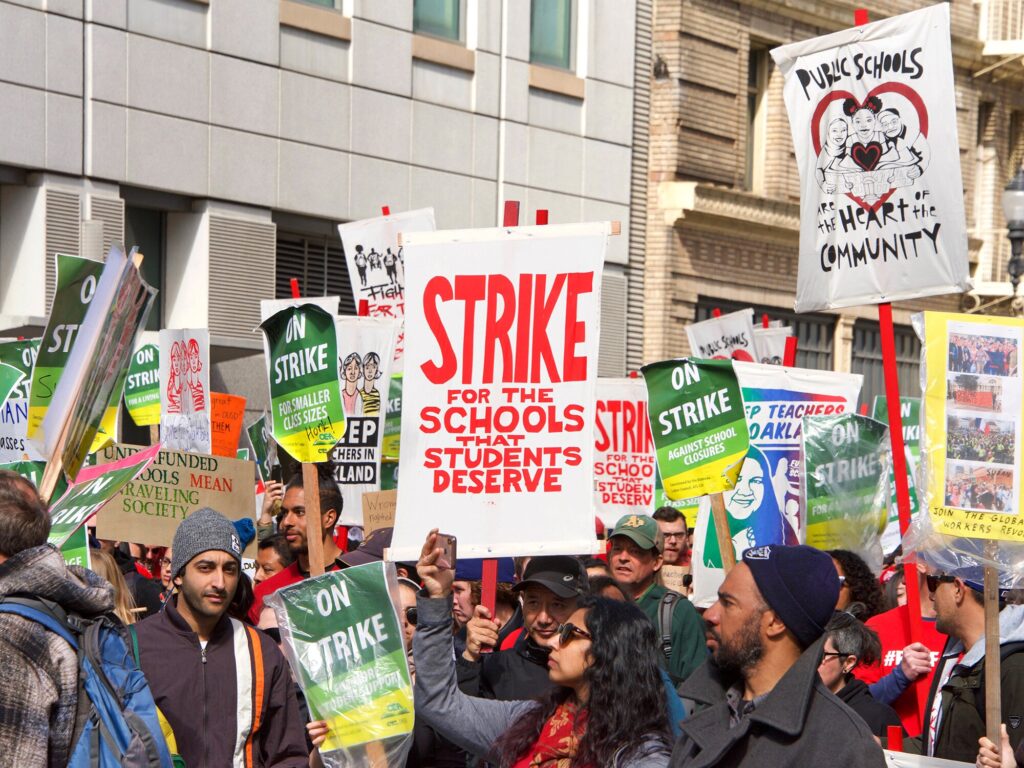
At the National Education Association’s 2018 representative assembly, delegates voted to create a fund to support teacher strikes in response to six statewide teacher strikes in West Virginia, Oklahoma, Kentucky, Colorado, Arizona, and North Carolina. This fund was established through individual donations from members of the NEA.34
Post-2024 Election Activities
In January 2026, NEA president Becky Pringle was listed as one of several speakers participating in a virtual event titled “Roadmap to Political Revolution” hosted by the Sunrise Movement. Other featured speakers included Sunrise Movement executive director Aru Shiney-Ajay; Maya Handle, New York City Mayor Zohran Mamdani‘s campaign manager and political advisor; Kat Abughazaleh, a Democratic primary candidate running for the U.S House seat representing Illinois’s 9th district; and U.S Rep. Ro Khanna (D-CA). 35
NEA and its leadership have issued sustained, sharply critical public statements about the second Trump administration since January 2025. NEA president Becky Pringle has issued dozens of press statements deriding administration policies, covering subjects including transgender student policy, diversity and inclusion programs, immigration enforcement, artificial intelligence regulation, and federal education funding. 36 37
In a January 2025 statement responding to a Trump-issued executive order limiting sex-reassignment treatments, Pringle said the order “attempts to dehumanize transgender, intersex, and non-binary people” and accused “politicians behind Project 2025” of seeking to “divide our nation.” In a separate statement that month responding to administration actions restricting diversity, equity, and inclusion programs, Pringle said President Trump and other “extreme politicians want to shut the door to equal educational opportunities for all children.” 36 37 38
Positions
Critical Race Theory
In July 2021, the National Education Association’s Representative Assembly passed a resolution encouraging the organization to “oppose attempts to ban critical race theory and/or The 1619 Project.” 39 It also expressed support for a rally on George Floyd’s birthday by the Zinn Education Project, a nonprofit that promotes the teachings of socialist activist Howard Zinn. 3940 Another resolution asked the NEA to fund opposition research on organizations “attacking educators doing anti-racism work.” 41
The NEA is also a member of the Partnership for Future Learning, a network of over 300 progressive organizations, which supports critical race theory (CRT). 42 The Partnership has released a messaging guide that describes ways to implement CRT. 43 A section titled “Reframing the Issue” asks teachers to downplay fears that “CRT inflicts emotional and psychological harm” on white children and shift towards emphasizing how diversity makes the U.S. stronger. 43
The messaging guide also criticizes conservative opponents of CRT, claiming that “coordinated efforts to control curriculum come from aggressive right-wing instigators.” 43 An attached resource guide from left-leaning activist group We Make The Future describes CRT opponents as “grifters who have peddled lies about our [2020 presidential] election.” 44
In 2021, a report card of various educational contractors and consultants was released by Parents Defending Education (PDE). The report listed consultants and organizations that work with schools and encourage them to implement Critical Race Theory and diversity, equity, and inclusion curriculums and policies. The report named the NEA as an organization supporting Critical Race Theory, and discussed the NEA’s decision in 2021 to allocate funds for the purpose of investigating parent groups and policy makers that opposed teaching Critical Race Theory in public schools. The report cited the NEA’s spending approvals for 2021 which included roughly $7.5 million for training union members to advocate for “racial and social justice” in the classroom, and “$32.9 million to elect union-friendly candidates, engage members ahead of the 2022 midterms, and ‘develop and utilize strategic research to shape debate in states about education funding, taxes, and revenue.’” 45
School Vouchers and Charter Schools
NEA has been a long time and vocal opponent of school vouchers used to help low-income students afford schools outside of their traditional district school. NEA claims that vouchers “reject students based on economic status, academic achievement, disability, or even gender.”46 NEA also claims that vouchers “divert essential resources from public schools to private and religious schools, while offering no real ‘choice’ for the overwhelming majority of students.”47
NEA has also taken a stand critical of charter schools, saying they have “weak regulation and lax oversight” which should be of “major concern to students, parents, taxpayer, and communities.”48
Immigration
NEA has positioned itself as a leading opponent of the Trump administration‘s immigration enforcement policies as they affect schools after the administration rescinded a federal policy that limited immigration enforcement at locations including schools, churches, hospitals, and other sites. NEA characterized the prior policy as having made such locations “safe havens” for children and families. The NEA filed a lawsuit with the American Federation of Teachers in Oregon in 2026 to limit immigration enforcement activities in such locations. 49
At NEA’s July 2025 Representative Assembly, delegates approved New Business Item 63, which committed the union to oppose federal immigration enforcement actions that it characterized as “kidnapping of student leaders” and to support “students’ rights to organize against ICE raids and deportations.” U.S. Representative Josh Brecheen (R-OK) said in response that it was “time to hold the super-woke NEA accountable.” 50 51 52
Other Issues
NEA has taken positions on issues both directly and indirectly related to education. It has supported public child nutrition programs,53 offered qualified support for the Common Core State Standards,54 and opposes voucher legislation.55 However, NEA has also taken stances on issue with little to no relation to education. For example, NEA has supported a path to citizenship for illegal immigrants,56 supported Obamacare,57 opposed the nomination of Neil Gorsuch to the Supreme Court,58 and supported barring people on the secret federal “no fly” list from being able to purchase guns with legislation that lacked proper due process protections.59
As of October 2025, it was reported that the NEA had provided the Zinn Education Project “prime space and opportunities to present at its conferences, partnered with them to design curriculums, united with the organizations to hold national teaching events, praised and promoted lessons developed by the groups in press releases, cited them in multiple teachers handbooks, and facilitated the dissemination of lesson plans they developed.” 60 In addition, the same report alleges that multiple NEA blog posts and press releases have promoted “the Zinn Education Project’s classroom materials, stating that the organization “promotes and supports teaching history accurately.”” 60
The NEA was among over 200 left-of-center organizations that criticized Target and other companies such as Anheuser-Busch after Target “reluctantly decided last week to pull some Pride Month merchandise from its shelves.” The coalition of groups, led by the Human Rights Campaign, urged Target to “provide necessary security for employees, restore Pride merchandise to its shelves, and stand by its commitment to the values it has long professed.” 61
Controversies
9/11 Terrorism
After the terrorist attacks on September 11, 2001, NEA issued guidelines on how teachers should discuss the attacks, urging teachers to show students how America had mistreated other people and nations, stressing the need for children to be tolerant of other cultures, and stating that teachers should not “suggest that any group [was] responsible” for 9/11. Instead, they urged teachers to have students “discuss historical instances of American intolerance.”62 Public outcry over the guidelines ensued, with Jan La Rue of Concerned Women of America saying, “It’s got their political spin all over it. The sentiment is what is wrong with America.”63
ACORN Donations
Also see ACORN (Defunct Nonprofit)
NEA also donated heavily to the now-defunct left-of-center community organizing group Association of Community Organizations for Reform Now (ACORN). From 2006-2008, NEA donated nearly $400,000 to a group that was accused of voter fraud, advising on how to dodge taxes, and more. NEA was later forced to retract support for ACORN, as then-president Dennis Van Roekel stated NEA was “stunned and appalled” by the “inexcusable actions.”64
Overt Democratic Party Activism
In a May 18 article in the Washington Post, American Political Science Association congressional fellow Chris Baylor stated that teachers unions such as the NEA and the American Federation of Teachers (AFT) “don’t increase teacher salaries. . . . But teachers’ unions do accomplish something politically notable: They are a vital part of liberal coalitions and the Democratic Party.”
Baylor argued that “when public-sector [e.g. teachers] unions lose power, so do liberal and Democratic causes.” Teachers unions have played a dominant role in the Democratic Party and its allies since the 1970s. “From early on,” Baylor said, “the NEA aimed to lead the liberal coalition. . . . [S]ince 1990, the AFT has been one of the top 10 contributors to federal campaigns in five election cycles, and NEA has been one of the top five contributors in seven.” 65
Anti-Defamation League Vote
According to an excerpt from its 2025 Handbook, the NEA’s description of International Holocaust Remembrance Day states that it on January 27 it will annually “recognize the more than 12 million victims of the Holocaust from different faiths, ethnicities, races, political beliefs, genders and gender identification, abilities/disabilities, and other targeted characteristics.” 66Later in the handbook, a section claims the NEA would use “digital communication tools” to “educate members on the difference between anti-Zionism and antisemitism.” 66
On July 5, 2025, during the union’s “2025 National Education Association Representative Assembly” in Portland, Oregon, representatives voted in favor of a proposal that would have the union sever ties with the Anti-Defamation League (ADL), which stated it “will not use, endorse, or publicize any materials from the Anti-Defamation League (ADL) such as its curricular materials or its statistics. NEA will not participate in ADL programs or publicize ADL professional development offerings.” 67The proposal also read that the union “will not…tolerate antisemitism, anti-Palestinian bias or hateful rhetoric or behavior.” 67Additional ADL materials that would have been reportedly banned under the proposal included “Holocaust curricula, statistics, and programs.” 68
On July 18, the NEA board of directors voted to reject the proposal, with NEA president Becky Pringle releasing a statement in which she said the NEA “opposes efforts to shut down debate, to silence voices of disagreement, and intimidation. … Not adopting this proposal is in no way an endorsement of the ADL’s full body of work…[w]e are calling on the ADL to support the free speech and association rights of all students and educators.” 69 Pringle’s statement also read, “We know antisemitism and anti-Arab bigotry are very real and urgent problems in this country and around the world … NEA and our members actively work to fight them in our classrooms, on our campuses, and in our communities.” 68
In October 2025, it was reported that the NEA sent a mass email to its membership that included a map labeling the entirety of Israel as “Palestine,” a link to an article the piece described as defending Adolf Hitler, and curricular materials from the Zinn Education Project, which promotes far-left interpretations of American history. According to Real Clear Education, the NEA subsequently removed the map and the link from its website. 70
Staff Union Lockout
In the summer of 2024, NEA management locked out roughly 300 of its own headquarters employees, represented by the National Education Association Staff Organization (NEASO), in a six-week labor dispute that disrupted the union’s annual Representative Assembly. 71 72
NEASO members struck for one day in June 2024 and again for three days in July 2024 during the union’s convention in Philadelphia, alleging unfair labor practices including withheld overtime pay. NEA management responded by locking out the roughly 300 NEASO-represented staff beginning July 7, 2024, after the second walkout ended the convention three days early. 71 72
Then-President Joe Biden, scheduled to address the convention, canceled his appearance, doing so roughly two weeks before he withdrew from the 2024 presidential race. Locked-out staff received no pay or benefits during the dispute, which centered on wage demands and telework policy, with the two sides reportedly more than $10 million apart on compensation. NEASO president Robin McLean described the lockout as “union-busting” and said the union’s own staff had been treated as “not humans.” NEA executive director Kim Anderson and McLean announced a tentative contract agreement in August 2024, ending the lockout. 71 72
Brandeis Center EEOC Complaint
In May 2026, the Louis D. Brandeis Center for Human Rights Under Law filed a federal civil rights complaint against NEA with the U.S. Equal Employment Opportunity Commission (EEOC), alleging the union fosters a hostile, antisemitic work environment and uses race- and ethnicity-based criteria for leadership and representation opportunities that disadvantage Jewish members. The complaint asked the EEOC to order NEA to “cease and desist” from classifying members by race and ethnicity for leadership purposes, arguing the practice discriminates against Jews and others categorized as “White.” 73 74
Much of the complaint centered on the union’s July 2025 Representative Assembly in Portland, Oregon, where the Brandeis Center alleged that delegates aligned with anti-Israel advocacy positioned themselves near members of the union’s Jewish Affairs Caucus, shouted down Jewish participants, and created an atmosphere in which Jewish delegates “reasonably feared retaliation and physical harm” during debate over the proposal to sever ties with the Anti-Defamation League (ADL). NEA did not respond to requests for comment on the complaint. The complaint followed an investigation opened by the House Committee on Education and Workforce into antisemitism at NEA, as well as a separate inquiry by Sen. Bill Cassidy (R-LA), the chairman of the Senate Health, Education, Labor and Pensions Committee. 74 75
Financial Information
Revenues
NEA is predominantly funded by member dues and “agency fees” paid by teachers obligated to be represented by the union in non-right-to-work states. 76 At least in previous years, NEA has received more in dues than the Service Employees International Union (SEIU).64
As of 2020, NEA reported total assets of over $411 million, income of over $390 million, and expenses of over $377 million. Roughly $369 million of the NEA’s income came from NEA membership dues; the rest came from areas including loan repayments, interest, dividends, rents, reinvestment, and Investment. 77
State Affiliate Grants
NEA distributes gifts and grants each year predominantly to its statewide affiliates, such as the California Teachers Association, which has received the largest sum ($10,599,007).78
Affiliates
NEA Foundation
Also see NEA Foundation (Nonprofit)
The NEA Foundation is NEA’s affiliated 501(c)(3) charitable arm, which itself offers grants and awards funded from teacher dues, corporate sponsors, foundations, and other donors. The NEA Foundation was founded in 196979 and has given “more than $7.1 million to fund nearly 4,500 grants to public school educators.”80 NEA president Becky Pringle also sits on the board of directors of the NEA Foundation.81
As of 2026, the president and CEO of the NEA Foudnation was Sara Sneed, who joined the organization in 2013 and had previously worked for the Hartford Foundation for Public Giving, where she was the director of education investments. 82
The NEA Foundation has received over $75,000 grants from large corporate and foundational donors such as AT&T, Bank of America, and the Bill and Melinda Gates Foundation. The NEA Foundation has also received tens of thousands of dollars from BET, Southwest Airlines, Prudential Insurance Company of America, and more.83
The NEA Foundation also awards grants of up to $5,000 to NEA members to support professional development and academic achievement.84 Other state teacher associations received over $2 million from NEA, including those in Michigan, Ohio, Illinois, Pennsyvlania, Washignton, New Jersey, Texas, Maryland, Massachusetts, and Alabama.78
NEA Advocacy Fund
Also see NEA Advocacy Fund (527 PAC)
The NEA Advocacy Fund is the National Education Association’s 527 political action committee. It was created in 2010, and has received millions of dollars in donations from the NEA, its primary funder. In the 2014 election cycle, the NEA Advocacy Fund received $21.8 million and gave $20.9 million, mostly to other political action committees and the national Democratic Party. In the 2016 election cycle, it raised $18.2 million and spent $18.7 million, mostly on donations to other political action committees and broadcast advertisement. In the 2020 election cycle, the fund raised $25 million and spent a similar amount, and the group raised over $30 million in 2022, spending over $29 million. 85 In the 2024 election cycle, the fund spent over $29 million, spending over $29 million in contributions to Democratic aligned groups, including making seven-figure donations to the Senate Majority PAC, House Majority PAC, Future Forward USA, and the Democratic Governors Association (DGA). 86
People
As of 2026, Becky Pringle was the president of the NEA. 87 She previously worked as a middle school teacher, 88 and was a member of the board of directors for the Pennsylvania State Education Association before moving to NEA. She spent six years as NEA’s secretary-treasurer before becoming NEA’s vice president, and was elected as president in 2020. 89 90 87
In 2014, President Barack Obama appointed Pringle to the President’s Advisory Commission on Educational Excellence for African Americans. 91
Vice President
Princess R. Moss was the vice president of the NEA as of 2026. 92 Moss was previously served the secretary-treasurer of the NEA before being elected to vice president in 2020. 90 She is a former president of the Virginia Education Association 93 and in 2006 was appointed by then-Virginia Governor Tim Kaine (D) to work in the Virginia State’s P-16 Education Council. She also served on the Executive Committee of nonprofit organization Foundation for Virginia. 92
Secretary-Treasurer
Noel Candelaria was the secretary-treasurer of the NEA as of 2026. Elected to his position in 2020, he was previously vice-president and later president of the Texas State Teachers Association (TSTA), as well as president of the Ysleta Teachers Association (YTA). 94
Executive Director
Kim Anderson was the executive director of the NEA as of 2026. Initially elected to the position in 2019, she previously worked at the NEA for over 15 years, including time as senior director of the NEA’s Center for Advocacy and Outreach, as well as leading the NEA’s government relations division. 95 Prior to the NEA, she served as executive vice-president of Democracy Alliance, worked as both deputy legislative director and legal counsel to former Virginia Senator Sen. Charles Robb (D-VA), and previously worked for the Central Committee of the Democratic Party of Virginia. 95
Financial Statistics
Total Assets
Total Revenue
Total Expenses
| Year | Total Assets | Total Revenue | Total Expenses | Filing |
|---|---|---|---|---|
| 2025 | $432,701,410 | $408,913,922 | $409,287,755 | View |
| 2024 | $442,991,930 | $402,754,752 | $411,051,955 | View |
| 2023 | $428,428,790 | $388,350,946 | $399,376,706 | View |
| 2022 | $442,485,024 | $378,223,972 | $389,232,297 | View |
| 2021 | $457,337,223 | $396,836,869 | $380,669,830 | View |
| 2020 | $432,009,050 | $396,541,924 | $377,104,948 | View |
Revenue Detail
Employee Compensation
- Number of Employees: 596
Highest Earning Employees
Grant Activity
All-time grants received statistics from Candid dataset:
- Total Grant Value: $2,802,549
- Number of Grants: 22
- Number of Funders: 16
Selection of highest value grants received from the last seven years:
All-time grants given statistics from Candid dataset:
- Total Grant Value: $1,131,559,758
- Number of Grants: 1,819
- Number of Recipients: 618
Selection of highest value grants given from the last seven years:
Mentioned in this Article
- 2025 Presidential Transition Project (Project 2025)
- 350.org (National)
- ACORN
- America Votes Action Fund
- American Federation of Labor-Congress of Industrial Organizations (AFL-CIO)
- American Federation of Teachers (AFT)
- Anti-Defamation League (ADL)
- Barack Obama
- Becky Pringle
- Bernie Sanders
- California Teachers Association (CTA)
- Catalist
- Center for American Progress (CAP)
- Center for Responsive Politics (Open Secrets)
- Concerned Women for America
- Congressional Black Caucus Institute
- Congressional Hispanic Caucus Institute
- Defending Education
- Democracy Alliance (DA)
- Democratic Governors Association (DGA)
- Department of Education
- Department of Labor
- Future Forward PAC (FF PAC)
- Gates Foundation
- George Washington University
- Hillary Clinton
- House Majority PAC
- Howard Zinn
- Human Rights Campaign
- International Brotherhood of Electrical Workers (IBEW)
- Joe Biden
- Lily Eskelsen Garcia
- Louis D. Brandeis Center for Human Rights Under Law
- Media Matters for America
- National Committee on Pay Equity (NCPE)
- National Education Association (NEA)
- National Education Association (NEA) Advocacy Fund
- National Urban League
- NEA Foundation
- Partnership for the Future of Learning
- Pennsylvania State Education Association (PSEA)
- Progressive (Progressive, Inc)
- Progressive States Network (PSN)
- ProgressNow
- Senate Majority PAC
- Service Employees International Union (SEIU)
- State Engagement Fund
- Sunrise Movement
- Target Corporation
- Texas State Teachers Association
- The Fairness Project (TFP)
- The Strategic Victory Fund
- Trump Administration
- UnidosUS (formerly National Council of La Raza)
- United Federation of Teachers (UFT)
- We Make the Future (WMTF)
- Zinn Education Project
- Zohran Mamdani
Associated Influence Networks
Teachers Unions
Teachers unions, like other government-employee unions, are a key player in the left-of-center infrastructure. The national teachers unions — National Education Association (NEA) and American Federation…
Associated Groups & People

Middle East Activism Network
MENA activism refers to individuals and organizations that seek to influence policy and opinion regarding issues related to the Middle East and North Africa region,…
Associated Groups & People

Public Funds Public Schools
Public Funds Public Schools (PFPS) is a teachers’ union-aligned campaign started by the controversial left-wing extremism watchdog Southern Poverty Law Center (SPLC), its affiliated SPLC…